Start With the Job the Tractor Must Do
Before you look at paint, tyres or the cab finish, match the tractor to the work it must handle. A unit for raking and spraying on a small holding will not need the same power, lift capacity or hydraulic output as a tractor used for ploughing, baling or hauling heavier implements across rough ground.
Write down the tasks first. Note the size of the land, the type of soil, the slopes, the implements you already own and whether the tractor must work in dry inland heat or humid coastal conditions. That way you avoid paying for power you will never use, or buying too little machine for the job.
- List the main jobs: mowing, spraying, towing, planting, or loader work.
- Check the horsepower range needed for those jobs.
- Confirm if you need 2WD, 4WD or shuttle shift.
- Measure the implements that must fit the tractor’s hitch and PTO.
Inspect the Engine, Fluids and Start-Up Behaviour
When viewing a tractor, start with the engine bay and the first start-up from cold if possible. A clean engine is not automatically a good engine, and an oily engine is not always a bad one. Look for leaks around gaskets, hoses, injectors, the radiator and the sump. In dusty farm use, blocked filters and poor cooling are common signs of neglect.
Watch the exhaust at start-up and under revs. Excessive smoke, hard starting, rattling or uneven idle can point to worn injectors, low compression or fuel system issues. Check oil level and colour, coolant condition and whether the radiator fins are bent or blocked. If the machine has been standing through load-shedding periods or long idle weeks, ask how it was stored and whether the battery and fuel system were maintained.
- Look for fresh sealant or recently washed engine parts.
- Check for milky oil, which may signal water ingress.
- Inspect coolant for rust or oil contamination.
- Listen for knocks, whine, or irregular idle speed.
Check Transmission, Hydraulics and PTO Operation
A tractor can look tidy but still cost plenty if the gearbox, clutch or hydraulics are tired. During the review, test every forward and reverse gear, the clutch response, the brakes and the steering. A hard gear shift, slipping clutch or noisy gearbox may mean repair work soon after purchase.
Hydraulics matter just as much. Raise and lower the three-point hitch, test remote valves if fitted, and see whether the arms hold position without dropping. Engage the PTO and check for smooth operation without strange vibration. If the tractor will run a mower, baler, spreader or pump, any PTO issue can stop work fast. Take time here, because small faults now can become expensive very quickly.
- Test the clutch for slip under load.
- Move through every gear and range.
- Check hydraulic lift speed and holding power.
- Confirm PTO engagement and disengagement are clean.
Review Tyres, Wheels and the Undercarriage
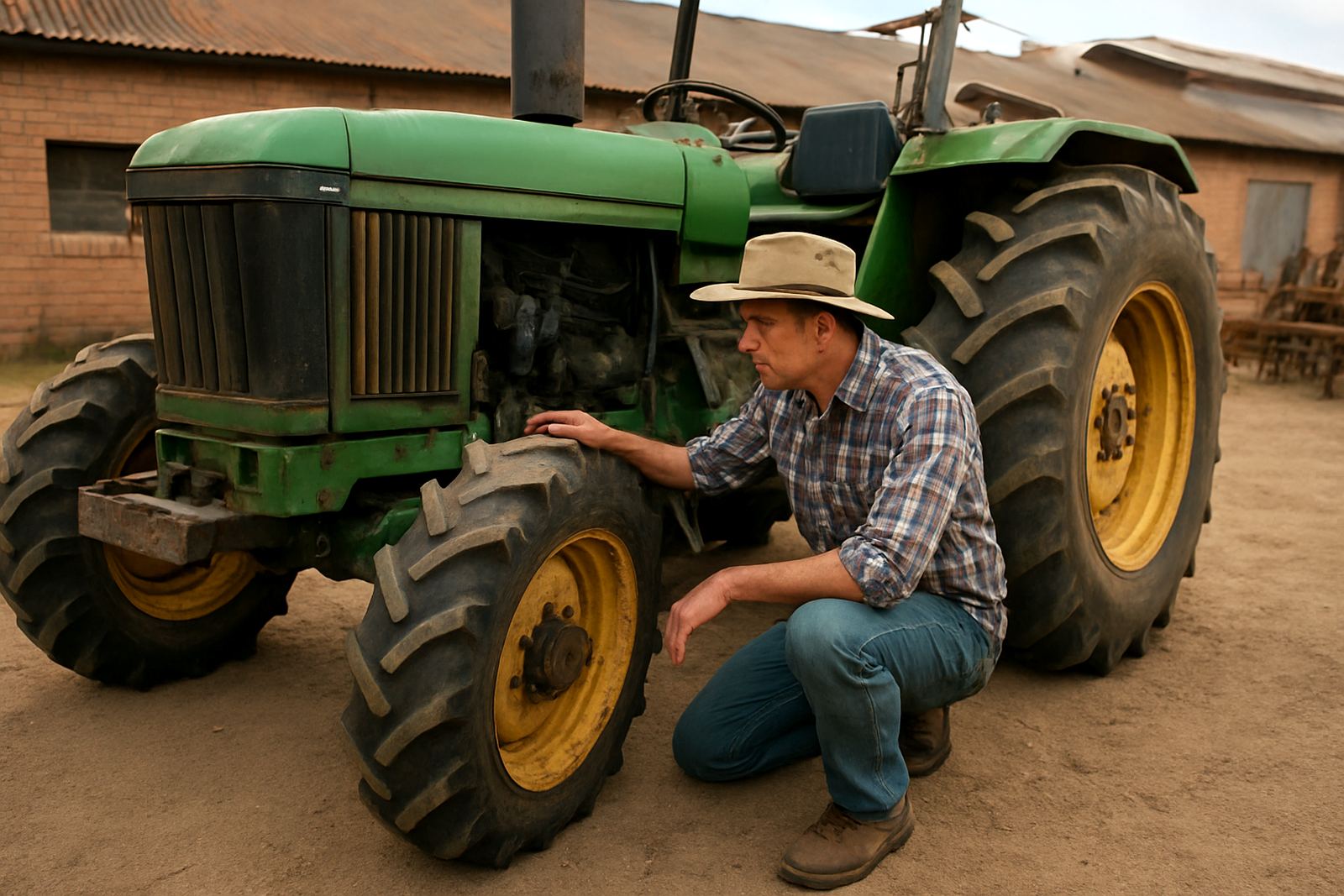
Tyres on farm tractors are costly, so they deserve close attention. Check tread depth, sidewall cracks, uneven wear and any signs of tyre separation. On a machine working in hot inland areas or near the coast, rubber can age faster than expected. If the tractor has mismatched tyres or badly worn fronts, factor that into your bid.
Look underneath for cracked castings, bent linkages, damaged guards and loose bolts. Check wheel rims for rust, especially where moisture and fertiliser storage may have affected the metal. If the tractor has done loader work, inspect the front axle, kingpins and steering joints for play. A little movement is normal, too much is not.
- Check for sidewall cuts and deep cracking.
- Look at rims for rust, dents and loose studs.
- Inspect the front axle for leaks or excessive play.
- Confirm all guards and covers are present.
Match the Paperwork to the Machine
Good paperwork saves time and trouble later. Before bidding, confirm that the lot description matches the machine on site, including make, model, serial number and any attachments listed. If the tractor is part of a dispersal sale or a larger farm clearance, check whether the sale includes the loader, canopy, weights or implements, or only the base unit.
Ask for clear information on ownership documents, payment terms, collection timing and whether the buyer must arrange transport. Some agricultural assets may need extra care with road movement, loading and municipal rules when moving through towns or crossing provinces. Make sure you know what is included in the sale and what is not, because assumptions cause problems.
Where possible, keep a written note of the lot number, serial number and condition comments from the viewing. That helps when you compare several tractors and need to decide quickly on auction day. It also makes it easier to spot a mismatch before you commit.
Set a Bid Limit and Plan for Collection
After the review, set your top bid before the auction starts and stick to it. Add room for tyres, filters, batteries, transport, minor repairs and possible downtime. A tractor that seems cheap can become expensive once you add collection from Germiston, Johannesburg East, Pretoria, Durban, Cape Town or Bloemfontein and then pay for the first round of maintenance.
Plan collection before you buy. Know what transport you need, whether the machine starts and drives, and whether any attachments must be removed for loading. If the tractor is going to a farm far from your base, check access roads, gate widths and trailer capacity before collection day. That small step can save a lot of hassle, and a missed detail can hold up the whole move.
For buyers comparing several lots, write down each tractor’s hours, condition, tyre state, hydraulic response and paper trail. A simple score sheet makes it easier to compare machines fairly instead of getting caught by a shiny bonnet or a rushed decision.