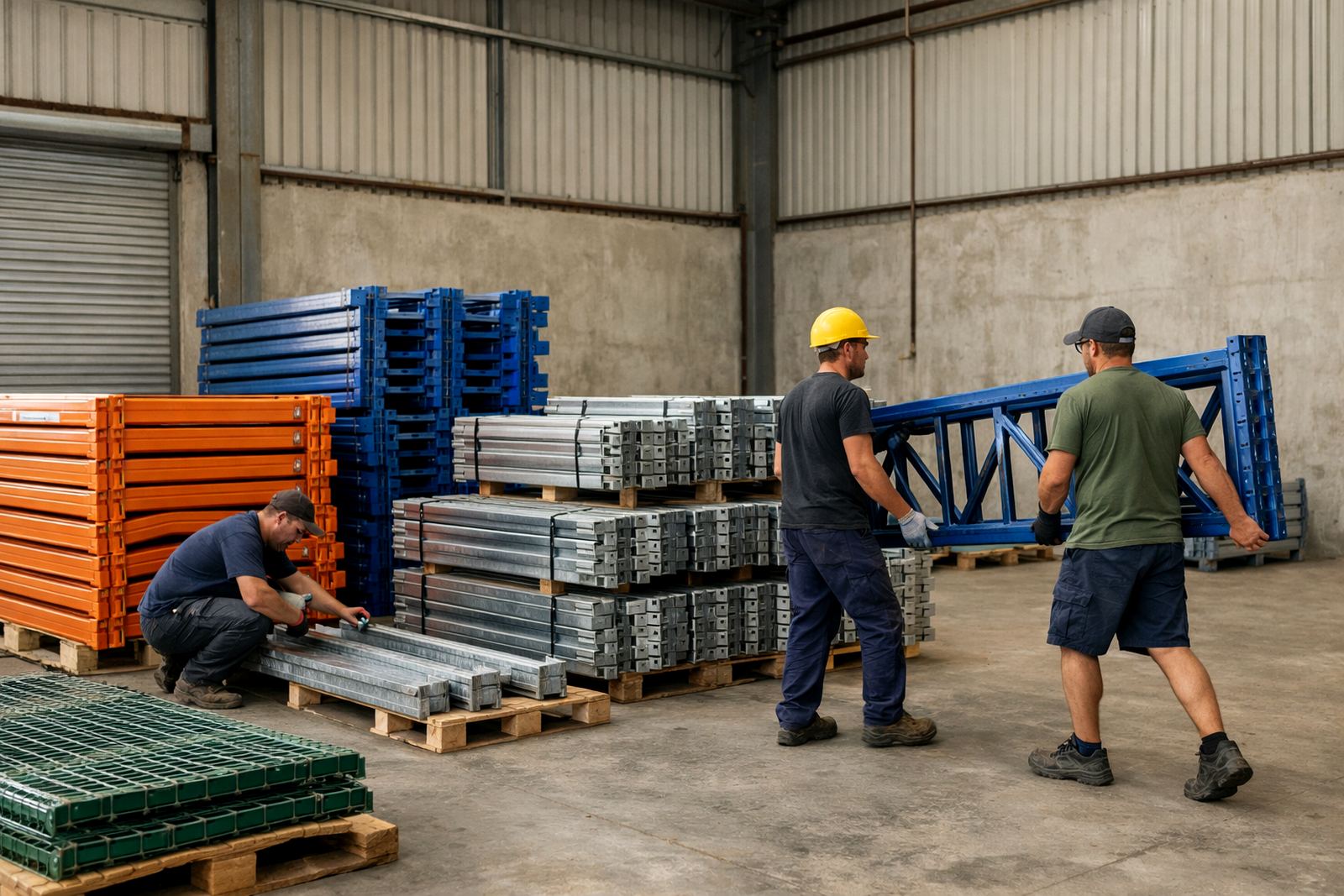
Start with a full count, not a rough estimate
Racking sales go wrong when a seller treats the stock as one lumped item. Buyers need to know how many uprights, beams, wire decks, base plates and braces are included, and they need those numbers to match what is standing in the warehouse. A proper count also helps prevent disputes on collection day, which matters when the site is busy or the building still has active operations around it.
At Germiston, we often see racking that has been altered over time. One bay may have longer beams, another may have extra supports added after a load change and some sections may be missing labels altogether. The safest approach is to walk the whole line bay by bay, note the exact dimensions, and record anything that has been cut, bent or welded. That gives buyers a fair view and gives the seller cleaner results.
- Count each bay, upright set and beam size separately
- Record height, depth and beam length in metres or millimetres
- Note missing components, rust, damage and any anchor issues
- Match the count to photos before the auction listing goes live
Measure the layout the way a buyer will install it
Racking is not just about how much steel there is. It is about whether a buyer can use it in their own warehouse. A set of 2.7 metre uprights with 2.4 metre beams is not the same as a mixed lot with different spans and depths. If the measurements are clear, a buyer in Johannesburg can decide whether it fits their narrow aisle, while a buyer in Durban can check if it suits a coastal store with moisture exposure.
Show buyers how the racking was used. Was it pallet racking, shelving, cantilever, drive-in or a mixture? Was it in a cold room, a dispatch area, or a bulk storage zone? These details affect value. If the installation sat in a humid coastal building for years, say so. If it is from a clean inland site with light surface dust only, note that too. Clear information saves time and improves trust.
- Measure bay widths, beam lengths and upright heights accurately
- State whether the layout is single deep, double deep or mixed
- Indicate if the racking was floor fixed and whether bolts are included
- Separate standard pieces from unusual or non matching sections
Group lots so the auction makes sense
The best warehouse racking auctions are not built around one huge lot unless the buyer pool is very specific. More often, the stock performs better when it is broken into logical groups. For example, one lot may cover 20 upright frames, another may cover 60 beams, and a third may include decking, end protectors and accessories. That lets smaller businesses bid on what they actually need instead of backing away from a pile that looks too large.
Lot grouping also helps when the site has mixed material. You may have heavy duty pallet racking on one side and lighter shelving on another. Keep those apart. The same goes for damaged stock, spare parts and loose items. If the lot list is clean, the auction is easier to follow and the viewing yard team can manage questions without confusion.
- Keep similar sizes and types in the same lot
- Do not mix damaged items with prime stock unless clearly marked
- Use lot notes to explain what is included and what is not
- Consider separate lots for beams, uprights, decking and accessories
Photographs should show the full run, not only the best side
Good photos are one of the biggest factors in buyer interest. For racking, the image set should show the full row, the end frames, the connection points and any visible wear. Buyers want to see how straight the uprights are, whether there is corrosion at the feet, and whether the beams have been overloaded. If the site is under load-shedding and the lighting is poor, use daylight where possible and take extra images from both ends of the aisle.
Include close-up photos of labels, damaged sections and measurements shown on a tape or marked notes. In a recent Germiston dispersal, the seller had racking spread across two warehouses and a small outside yard. Once the images were grouped by bay and the dimensions were listed clearly, the buyer response improved because people could compare what they were seeing with their own warehouse plans. That kind of clarity is worth more than fancy wording.
- Photograph each row from the front and side
- Capture close-ups of feet, connectors and beam ends
- Show rust, bending, dents or repair work honestly
- Use a measuring tape or marker board to confirm sizes
Viewing days need control, access and safe movement
Warehouse racking viewings must be managed carefully. Buyers often want to walk the aisles, check stability and estimate dismantling time. That is useful, but it needs supervision. Clear access routes, marked bays and a responsible supervisor on site make the process smoother. In busy industrial areas like Isando, Alberton and Johannesburg East, you also need to think about truck access, yard congestion and whether vehicles can stop safely for loading plans.
For racking sales, the viewing should focus on practical points: What tools will be needed? Can the buyer dismantle during working hours? Are there any restricted areas, safety rules or municipal conditions that affect collection? If the warehouse is inside an active logistics site, buyers should know whether collections will be after hours or during a set window. That avoids problems later.
- Mark the viewing route and any no-go zones clearly
- Confirm if buyers may inspect from ladders or platforms only
- Set out collection rules before the auction closes
- Make sure the site contact understands the lot order and access plan
A Germiston example: one racking job, several buyer types
A common local case starts with a factory in Germiston clearing surplus storage after a layout change. The site may have 120 bays of mixed pallet racking, some spare beams, and a few damaged frames pushed to one side. If that stock is sold as one vague heap, buyers hesitate. If it is counted, measured and grouped properly, the same stock can attract warehouse operators, traders and smaller businesses looking for starter capacity.
That is where disciplined auctioning helps. One lot might suit a logistics firm expanding in Pretoria, another may interest a Durban buyer replacing rusted coastal stock, and another might suit a Cape Town warehouse that needs a few extra bays for overflow. The seller benefits from broader interest, and buyers get a fair shot at stock that matches their needs. In a market where every Rand matters, clear lotting is what keeps the process moving.
For warehouse racking, the main rule is simple: count it properly, measure it properly and sell it in lots that make sense. If the buyer can understand the layout in a minute or two, the auction has a far better chance of producing clean bids and trouble free collection.